

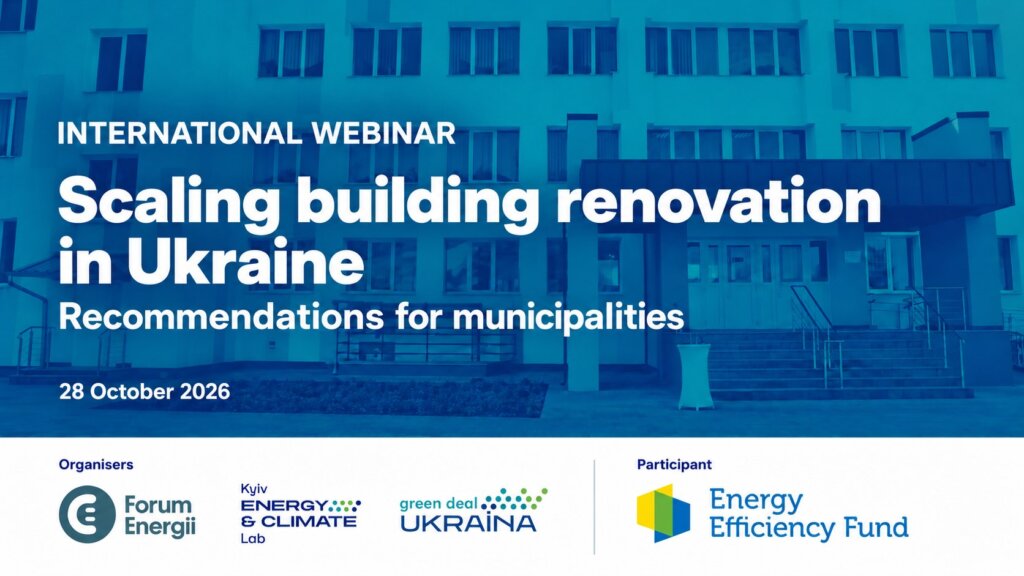
On 28 October, the international webinar “Scaling Up Building Renovation in Ukraine: Recommendations for Municipalities” took place. It was organised by the Green Deal Ukraїna project in cooperation with Forum Energii and Kyiv Energy and Climate Lab. The event brought together experts, municipal representatives and international organisations to discuss ways to accelerate the modernisation of residential and public buildings.
During the webinar, participants discussed major challenges. As of early 2026, only around 5% of Ukrainian municipalities had approved Municipal Energy Plans, which are a mandatory requirement for receiving state support for energy efficiency. In addition, approximately 80% of Ukraine’s 180,000 multi-apartment buildings still lack condominiums (OSBBs) and therefore remain outside the main grant application pathway.
To address these challenges, experts proposed a “municipal neighbourhood” approach. It involves coordinating the renovation of neighbouring multi-apartment buildings (including those without established condominiums) as part of an integrated project, alongside the modernisation of district heating systems and public buildings.
Yurii Zbyrаnyk, Head of the Sustainable Development Department at the Energy Efficiency Fund, joined the panel discussion “From Plans to Implementation: What Can Municipalities Really Do?”. Together with representatives of Lviv City Council, Forum Energii, GIZ and iC consulenten Ukraine, he discussed practical steps for putting these plans into action.
The Fund’s representative shared practical experience in implementing its programmes and highlighted two key factors behind the success of energy efficiency projects. The first is effective municipal management, with local authorities communicating their vision and encouraging residents to take action. The second is the power of neighbour-to-neighbour example: residents of modernised buildings encouraging their neighbours to follow suit, thereby generating significant demand.
As a notable example of effective local authority engagement, Yurii Zbyranyk cited the city of Novoiavorivsk. According to him, the city has just over 100 condominiums (OSBBs), more than 40 of which have already been modernised under the Energy Efficiency Fund’s programmes. This has been achieved largely thanks to the municipality’s strong expertise and proactive communication with residents.
Another source of pride is the restoration of damaged housing, where the power of neighbour-to-neighbour example has proved particularly effective. According to Yurii Zbyranyk, Irpin became a kind of pilot site for testing the conditions of the VidnovyDIM Programme. Of the 500 multi-apartment buildings damaged in the city, nearly 200 have already been restored with the Fund’s support. The process began with just one to three buildings but, thanks to communication between neighbours, gradually spread across entire streets and neighbourhoods. Today, nearly half of the city’s multi-apartment buildings have been restored with the Fund’s support, while applying the Build Back Better principle to improve their energy efficiency.
“Of course, the figures on the number of projects and buildings are very important,” emphasised Yurii Zbyranyk. “But for me, the Fund’s greatest achievement is not the statistics themselves. It is the fact that we encourage people to come together to make their buildings more energy-efficient, restore them, and even use renewable energy sources in their homes.”
Another important area of the Energy Efficiency Fund’s future work is the development of a municipal one-stop-shop model for building thermal modernisation in Ukraine. Together with Lithuanian partners, including APVA, and the city of Kryvyi Rih, the Fund has developed the concept for the LIFE BRIDGE-OSS UA project. The initiative aims to pilot this model, drawing on Lithuania’s experience and European best practices. The one-stop shop will help condominiums (OSBBs) navigate every stage of the thermal modernisation process — from assessing needs and preparing projects to securing funding, selecting contractors and implementing energy efficiency measures. The long-term goal is to develop a practical model that can be scaled up and introduced in other communities across Ukraine to accelerate the energy-efficient modernisation of buildings.